
Can you become a SOC analyst with no experience?
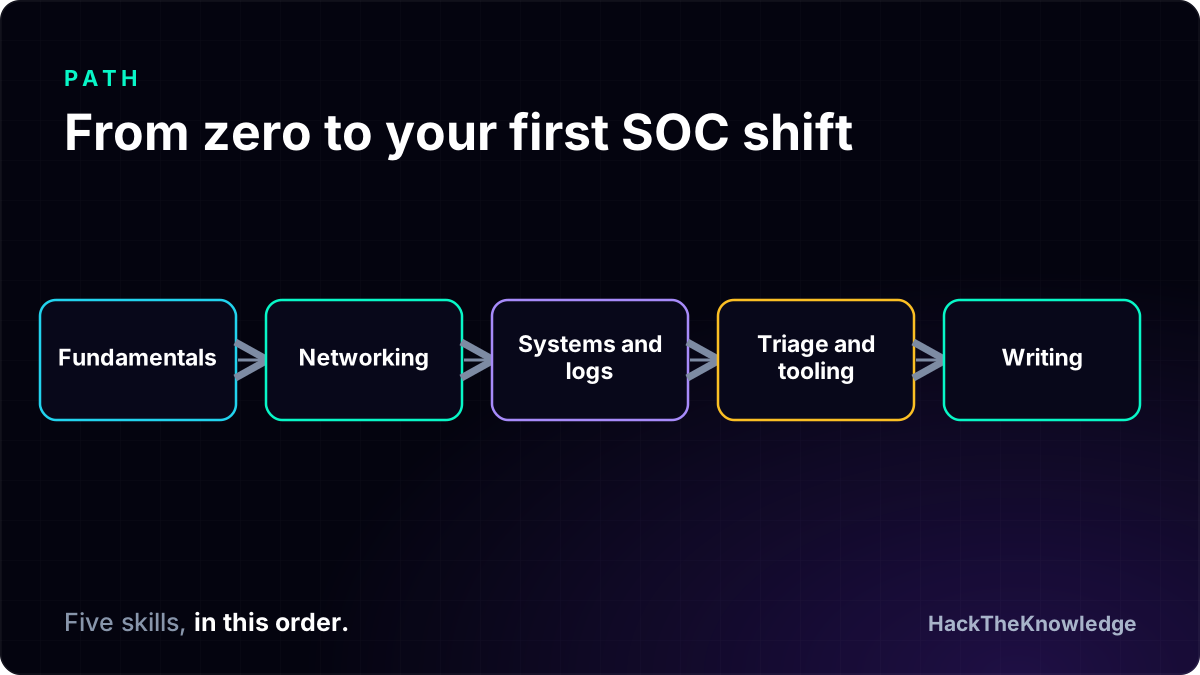
A Security Operations Center (SOC) is the team that watches an organisation for security incidents. It is staffed in tiers, and Tier 1 is where newcomers start. Nobody expects a Tier 1 analyst to reverse-engineer malware. They expect someone who reads an alert carefully, checks the evidence, reaches a defensible verdict and writes it down so the next person does not have to redo the work.
That is good news, because every part of that job can be practised before anyone pays you to do it. What follows is the order I would learn it in.
What does a Tier 1 SOC analyst actually do?
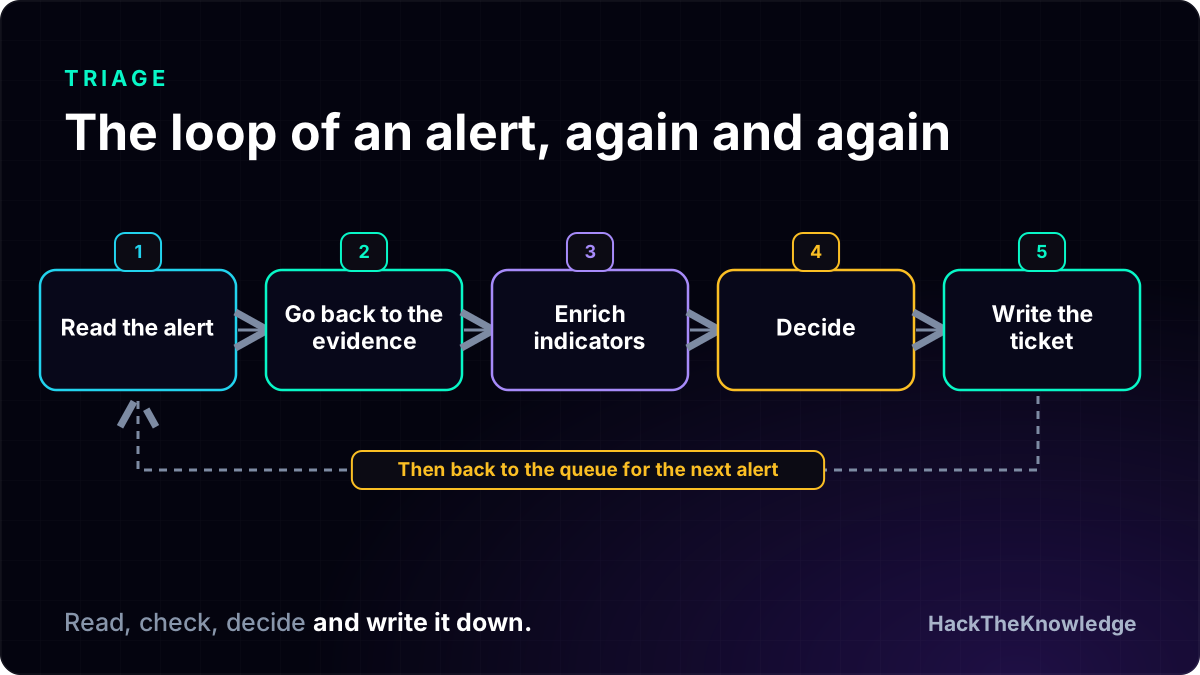
Most of the shift is one loop, repeated: an alert arrives in the queue, you work out what triggered it, you gather context, you decide, and you document.
- 1Read the alert. Which rule fired, on which machine or account, and when.
- 2Go back to the evidence. The alert is a summary; the logs or the email behind it are the facts.
- 3Enrich the indicators. Look up the domain, IP address or file hash in reputation sources, without tipping off the attacker.
- 4Decide. True positive or false positive, how severe, and whether to close, escalate or keep digging.
- 5Write the ticket. What you saw, what you checked, what you concluded and what you recommend.
If a term in that list is new to you, the SOC glossary defines each one in a paragraph.
Which skills should you learn, and in what order?
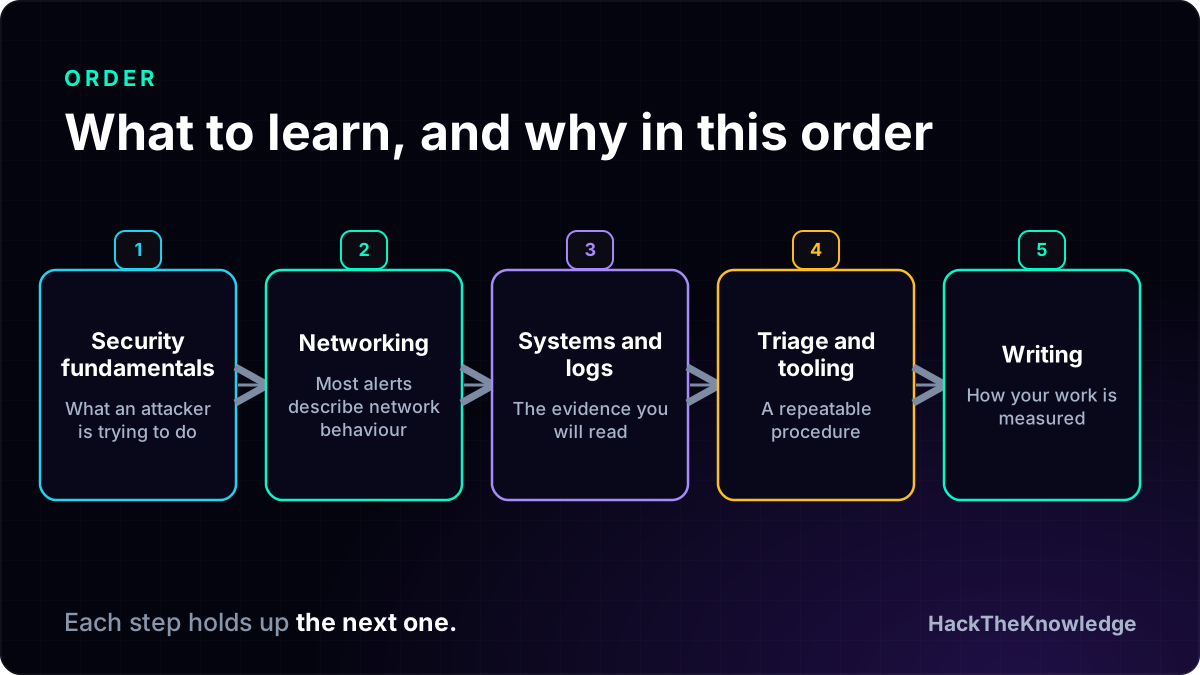
| Step | Skill | Why it comes here |
|---|---|---|
| 1 | Security fundamentals: threats, the CIA triad, how an attack unfolds | You cannot judge an alert without knowing what attackers are trying to do |
| 2 | Networking: IP addresses, ports, DNS, HTTP, TLS | Most alerts describe network behaviour, and logs are written in this vocabulary |
| 3 | Operating systems and logs: Windows events, Linux basics, process and authentication logs | This is the evidence you will be reading |
| 4 | Triage method and tooling: a SIEM, enrichment sources, MITRE ATT&CK | Now the previous three steps become a repeatable procedure |
| 5 | Writing: tickets and short incident reports | It is how your work is measured, and how an interviewer measures you |
Scripting helps but can wait. A little Python for parsing logs is useful from step 3 onwards; it is not a prerequisite for a first job.
Where can you practise for free?
Use more than one place. They are good at different things, and none of these needs a card to start.
- HackTheKnowledge. The free SOC analyst course teaches the triage method in order and has you practise it on an alert queue in a browser simulator that grades your verdict. It is available in English and Spanish, and the free networking course covers step 2.
- LetsDefend. A simulated SOC with an alert queue; its free plan is limited, but good for repetition once you have a method.
- CyberDefenders and Blue Team Labs Online. Investigation challenges built on real evidence such as packet captures, logs and disk images.
- TryHackMe. Guided rooms across a very wide range of topics, including a SOC path.
- Cisco Networking Academy. Free, structured fundamentals, also in Spanish.
- A home lab. An open-source SIEM such as Wazuh or Elastic on a virtual machine teaches you how the data gets there, which the hosted platforms hide.
How do you prove it without work experience?
A list of completed courses says you watched something. A written investigation shows you can do the job. Build a small portfolio of three or four write-ups, each following the structure of a real ticket:
- A phishing email analysed from the headers to the verdict.
- A suspicious domain or IP address investigated with public sources only.
- A set of Windows or authentication logs in which you found, and explained, the abnormal activity.
- One alert you judged to be a false positive, with the reasoning. Interviewers like this one because it shows judgement.
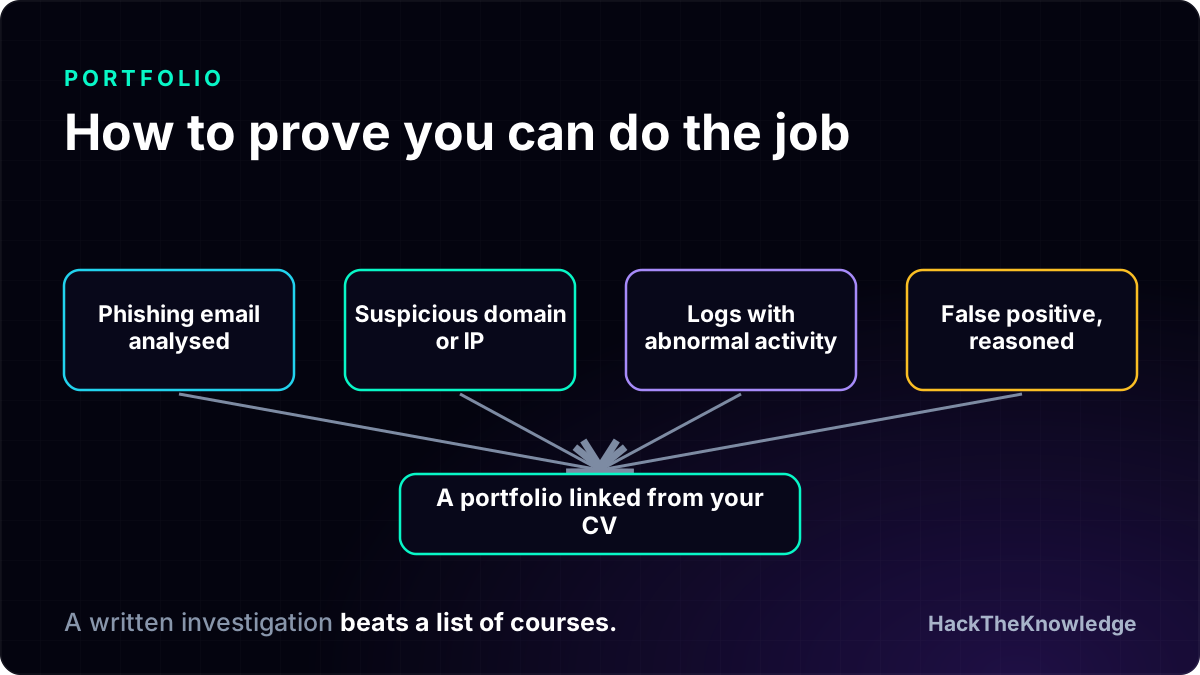
Keep each to a page, remove anything sensitive, and publish them where you can link to them from your CV. In an interview, expect to be handed an alert and asked to talk through what you would check; having done it dozens of times is what makes that comfortable.
Our perspective
When people ask how to start in a SOC, the question is rarely what to read. It is how to know they are doing it right. Reading about triage and doing triage are different skills, and the second only improves with feedback. That is why the free SOC analyst course is built around an alert queue that grades your verdict: you find out straight away whether the evidence supports your decision.
Fran